Challenge conventions.
A continuous quest for a better world.
Researcher ZHANG Lijie from the College of Chemistry and Materials Engineering Publishes Academic Paper in "Nature Nanotechnology", Sub-journal of Nature
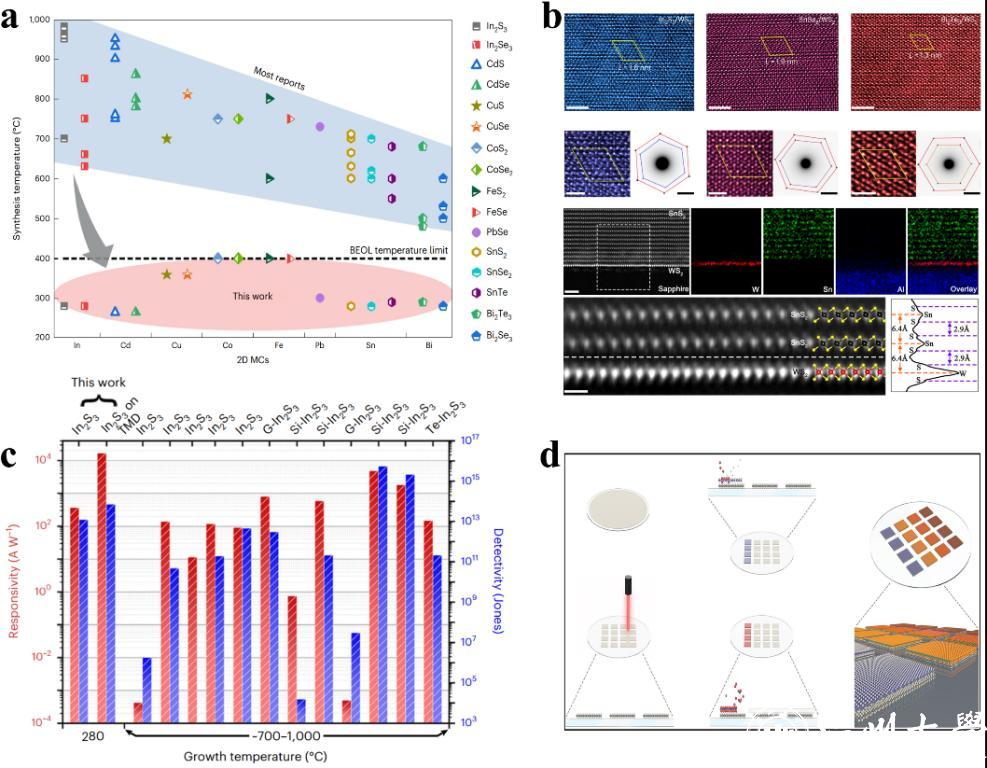
Two-dimensional materials possess novel physical properties such as atomic-level thickness, excellent electronic transport, and optoelectronic characteristics. They serve as ideal platforms for the development of high-performance electronic and optoelectronic devices, potentially extending the traditional silicon-based semiconductor industry based on "Moore's Law" and further enhancing chip transistor integration density. However, the process temperatures required for producing high-quality two-dimensional materials are generally higher than the temperature limits of standard semiconductor CMOS (complementary metal-oxide-semiconductor) chip fabrication processes, significantly restricting the integration of two-dimensional materials with silicon-based integrated circuits. Although integration of two-dimensional materials can be achieved through additional mechanical transfer processes, the samples produced using mechanical transfer methods are challenging to control in terms of product morphology and size, are time-consuming and inefficient, and often introduce chemical impurities at material interfaces, leading to a noticeable decline in material performance and hindering scalable applications. Therefore, achieving low-temperature direct growth of high-quality two-dimensional materials is an ideal solution to promote their practical applications in the semiconductor field.
Recently, researcher ZHANG Lijie and colleagues from our institute addressed the temperature constraints faced in the integration of two-dimensional materials, heterostructures, and semiconductor chip monolithic integration. They first developed a van der Waals substrate-assisted low-temperature epitaxial growth strategy for the controllable growth of a series of two-dimensional metal iodides (PbI2, CdI2, BiI3, CuI) at relatively low temperatures. Combined with theoretical calculations, they elucidated the impact of diffusion barriers on the growth of two-dimensional iodides, providing strategies and theoretical guidance for low-temperature growth of high-quality two-dimensional materials. This research achievement was published in the prestigious international academic journal "Advanced Functional Materials" in the field of materials.
Building upon this foundation, Researcher ZHANG Lijie and team designed a universal van der Waals substrate-assisted low-temperature in-situ substitution growth method for two-dimensional metal iodides. They successfully achieved ultra-low-temperature controllable growth (≤ 400°C) of 17 high-quality two-dimensional metal chalcogenides and their heterostructures. Combining theoretical calculations, they elucidated the mechanism of ultra-low-temperature in-situ substitution growth, revealing the microscopic essence of sulfur element replacing iodine element with low substitution barriers. Moreover, they achieved large-area array integration of various two-dimensional materials and their heterostructures at temperatures below 400°C. This research offers a feasible solution for the temperature compatibility issue in the backend manufacturing process of two-dimensional materials and semiconductor chips and provides a new approach for the monolithic integration of two-dimensional materials and their heterostructures. The research paper titled "Epitaxial substitution of metal iodides for low-temperature growth of two-dimensional metal chalcogenides" was published in Nature Nanotechnology sub-journal of Nature, with Wenzhou University as the joint corresponding unit. Researcher Zhang Lijie from College of Chemistry and Materials Engineering, Lain-Jong LI from the University of Hong Kong, Zhengtang LUO from the Hong Kong University of Science and Technology, and Shaoming HUANG from Guangdong University of Technology are the joint corresponding authors. Young faculty member ZHAO Mei from College of Chemistry and Materials Engineering is the joint first author.
2024-03-04
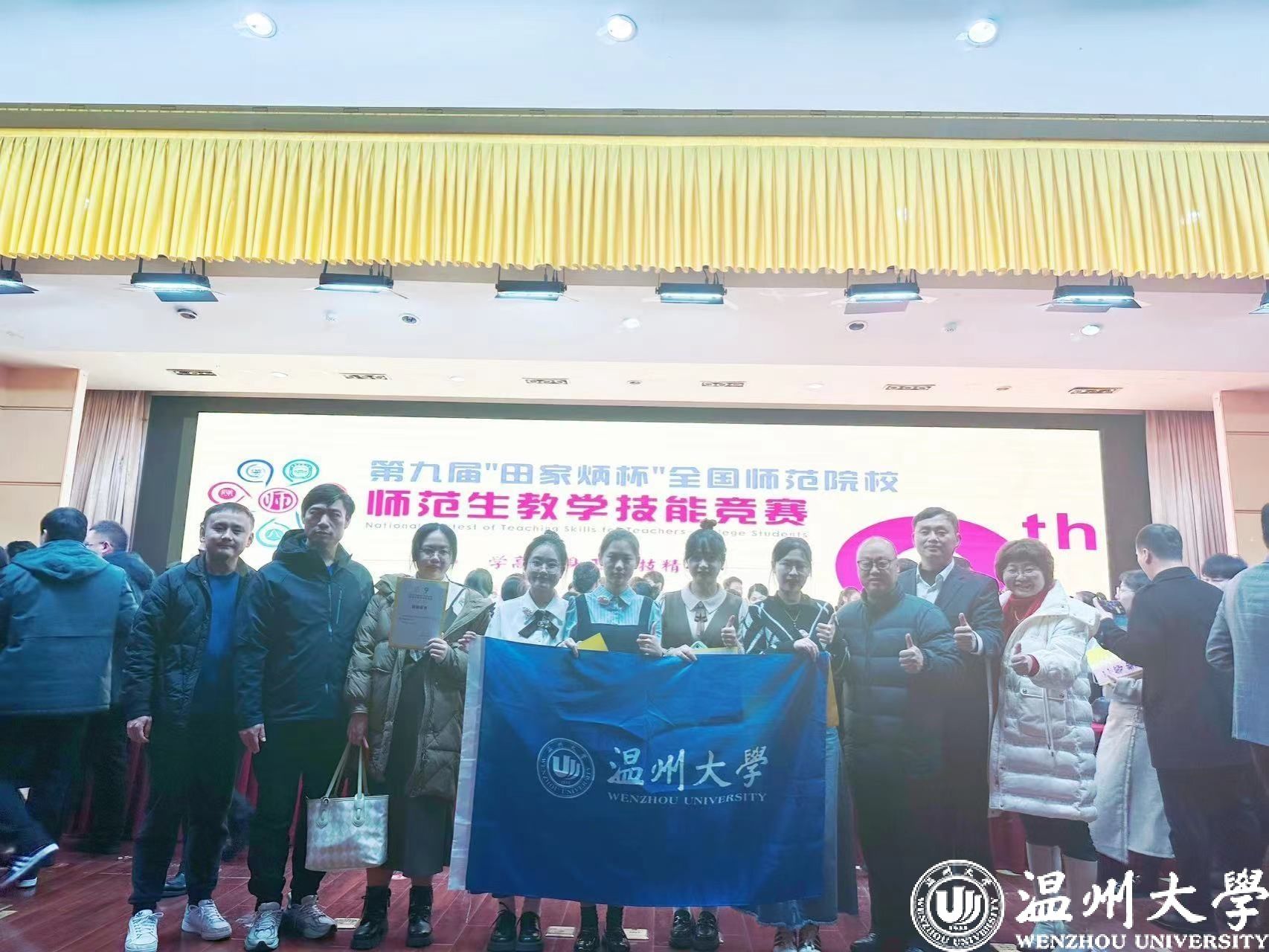
WZU Education Majors Achieve Sixth Place Nationwide in the 9th "Tian Jiabing Cup" National Teaching Skills Competition From December 29th to 31st, the finals of the 9th "Tian Jiabing Cup" National Teaching Skills Competition for education majors were held at Zhejiang Normal University. A total of 1611 participants from 226 universities nationwide competed in this event, with 10 participants from our university. They achieved 4 first prizes, 1 second prize, and 5 third prizes, ranking sixth in the nation for the number ...
2023-10-17
Researcher ZHANG Lijie from the College of Chemistry and Materials Engineering Publishes Academic Paper in "Nature Nanotechnology", Sub-journal of Nature Two-dimensional materials possess novel physical properties such as atomic-level thickness, excellent electronic transport, and optoelectronic characteristics. They serve as ideal platforms for the development of high-performance electronic and optoelectronic devices, potentially extending the traditional silicon-based semiconductor industry based on "Moore's Law" and further enhancing chip tra...International Relations Office, Wenzhou University
Postal Address: 6th Floor, Administrative Building, South Campus, Wenzhou University, Chashan University Town, Wenzhou City, Zhejiang Province, China 325035
Tel: 0086-577-86680971 86598029
Fax: 0086-577-86598029
E-mail: fao@wzu.edu.cn